
Contract Services
Chemical Polishing for Precision Small Parts
Electropolishing needs an electrode with line of sight to the surface. Chemical polishing does not. It is an immersion process: the solution acts on every surface it contacts, including micro-bores, cross-holes and internal geometries that abrasive media and electrodes cannot physically reach. We polish parts you supply, or work from drawings with machining and polishing handled as a single package.
What We Process
Precision small parts where surface roughness, cleanliness and corrosion resistance are specified.
Capillary & small-bore tubing
Uniform bore treatment using purpose-built equipment
Bellows & corrugated tubing
Solution exchange inside the convolutions
Micro-hole components
Reaches bores no abrasive media can enter
Complex internal geometries
Immersion acts on the full wetted surface
Materials: primarily austenitic stainless steel. Titanium and copper alloys are assessed case by case. Part size is limited by tank dimensions — send a drawing with overall dimensions and we will confirm feasibility.
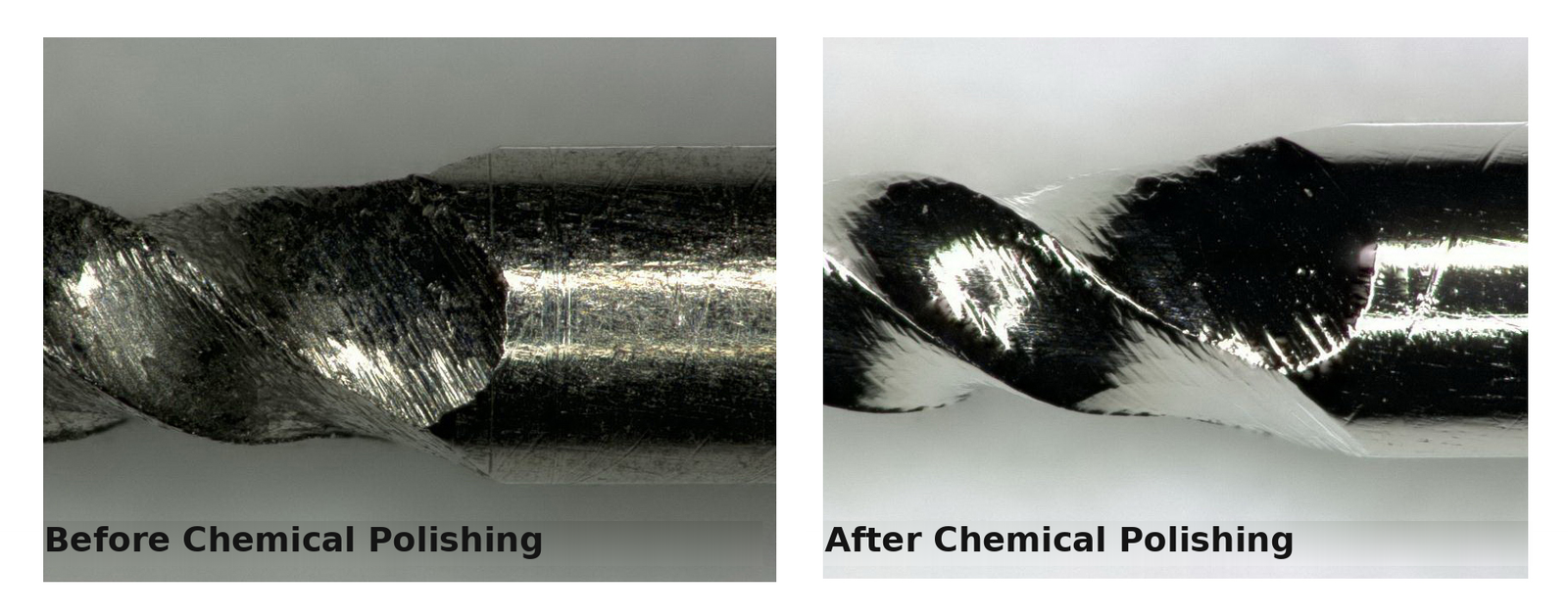
A spiral groove on a small-diameter component, processed uniformly down to the groove floor. Neither abrasive media nor an electrode can reach this geometry, but the solution acts on every surface it wets. Machining burrs dissolve from the root, so no secondary burr is left behind.
Two Ways to Engage
Depending on where your project stands, we take work in either of two forms.
A
Polishing of customer-supplied parts
Ship us finished parts and we chemically polish them. Most of our work is on fine and complex geometries that mechanical and electrochemical methods struggle to reach. Deburring, roughness reduction and improved corrosion resistance happen in a single process step.
B
Build to print (machining + polishing)
We take the project from the drawing. Machining is handled by partner shops we have worked with for years; parts then come to us for chemical polishing and ship as a finished item. If your drawing calls out electropolishing, chemical polishing is often a viable alternative depending on geometry — worth raising early.
Where we differ
Geometries where solution exchange is the real problem
Immersion reaches the surface, but immersion alone does not guarantee a uniform result. In confined geometries the solution at the wall becomes depleted and the reaction stalls before it becomes uniform. We developed the equipment and process controls for these cases in house.
Inside bellows convolutions
Flow behaves differently at the crest and at the root of each convolution, which has made uniform reaction on bellows interiors difficult. We run a dedicated cleaning and polishing sequence developed for this geometry.
Extreme aspect ratios
In tubing that is very long relative to its bore, the solution inside does not turn over and the reaction varies along the length. No off-the-shelf equipment reproduces production conditions at these ratios, so we built our own.
Micro-holes and shadowed features
Micro-holes that admit no abrasive or electrode, and the far side of blind holes, are processed as long as the solution wets them. Fixturing and conditions are worked out per part.
Send a drawing and we will tell you whether the geometry is workable.
Resulting Surface Condition
Chemical polishing leaves the surface in the following condition.
Smooth, specular finish
Microscopic peaks dissolve preferentially and the surface levels out, reducing flow resistance and particle generation. Ra 0.17 µm measured on the bore of a 0.2 mm ID capillary (laser microscope). Simpler geometries can reach lower values. Achievable roughness depends on geometry and material.
Burr-free
Burrs dissolve from the root, so no secondary burr forms. Cross-holes and blind-hole interiors that resist mechanical deburring and electropolishing are deburred wherever the solution reaches.
Low adsorption
Dangling bonds left by machining are terminated with hydroxyl and hydrogen groups during chemical polishing. Charged particulates adhere less readily, which helps the surface stay clean.
Corrosion resistance
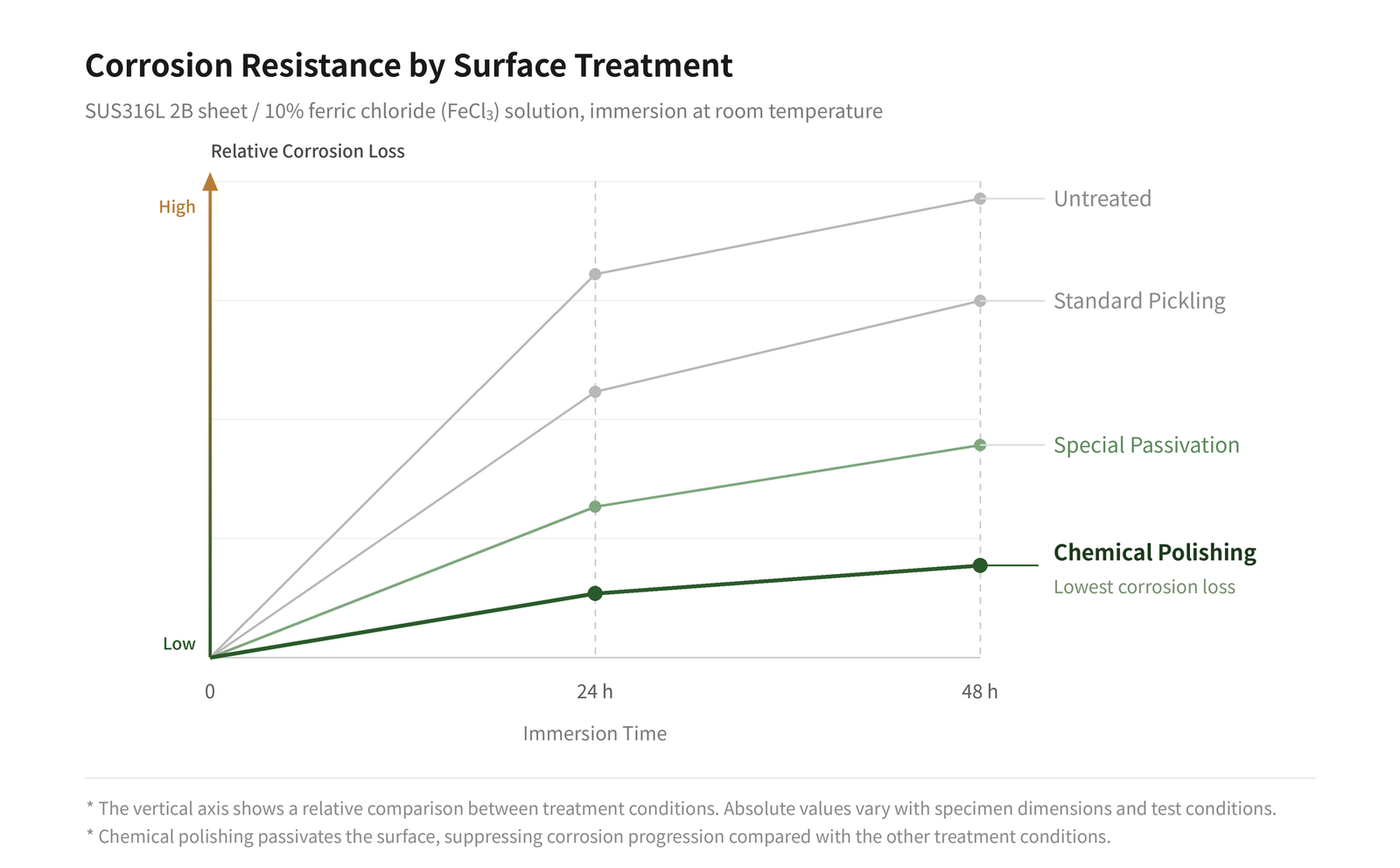
The surface is passivated. In a 10% ferric chloride (FeCl₃) immersion test at room temperature on 316L 2B sheet, corrosion after 48 hours was substantially below the untreated control. Comparison data against standard pickling and specialised passivation is available below.
Improved Cr/Fe ratio
Surface Cr/Fe rises and a chromium-enriched passive film forms. Surface chemical analysis is commissioned from third-party laboratories including RJ Lee Group, to SEMI standards. Reference data shown here was measured on a different product in a different material. The achievable value is bounded by base material quality and cannot exceed what the substrate allows.
Corrosion resistance comparison
316L 2B sheet immersed in 10% ferric chloride (FeCl₃) at room temperature, comparing how corrosion progresses under four surface conditions tested in parallel: untreated, standard pickling, specialised passivation, and chemical polishing. The chemically polished specimen showed the least progression at 48 hours.
How the surface differs from mechanical polishing
Mechanical and chemical polishing leave fundamentally different surfaces. In SEM imaging at 3,500× commissioned from RJ Lee Group, the mechanically polished surface retains directional striations from the abrasive, while the chemically polished surface shows those striations gone and grain boundaries visible. The valleys of a striation trap particulates and oil that cleaning does not always remove. Chemical polishing levels the surface by dissolution, so those trapping sites never form.
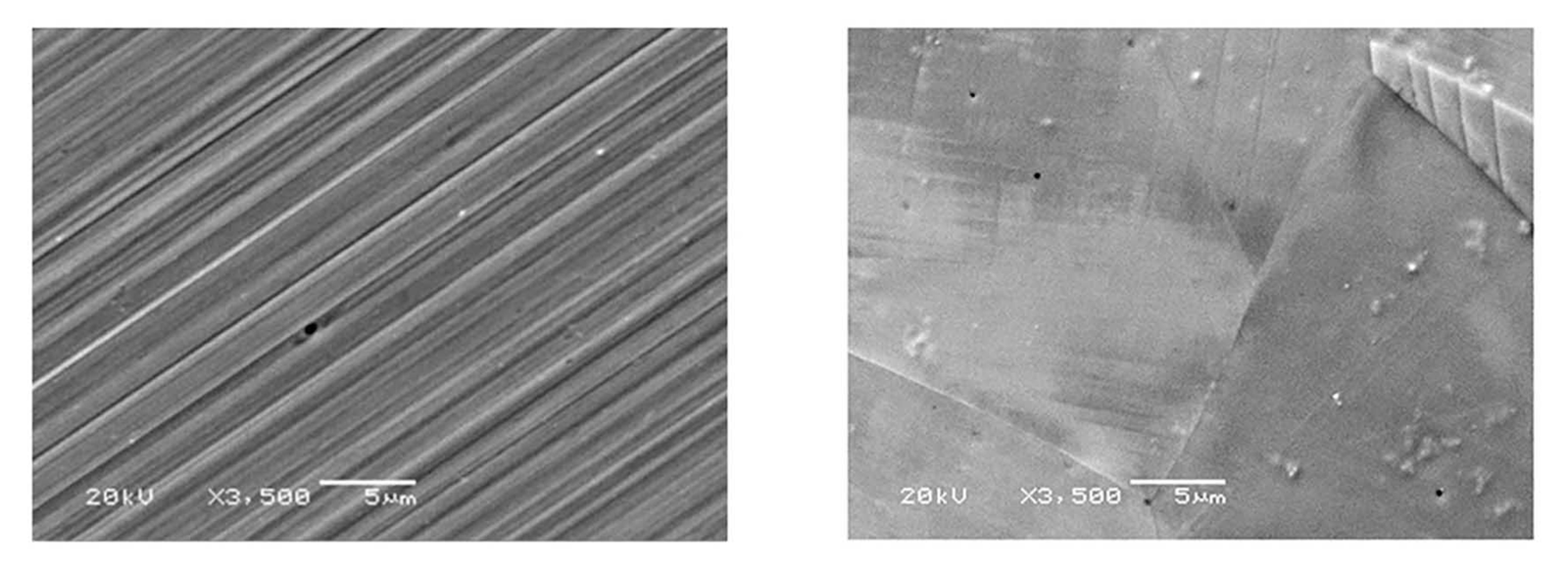
*SEM imaging by RJ Lee Group (3,500×, SUS316L VIM+VAR) — left: mechanically polished surface, right: chemically polished surface
*Reference data. Measured on a different product in a different material, not on capillary tubing.
How a Project Runs
STEP 01
Inquiry
Send drawings, specifications and requirements. We confirm whether the part is workable.
STEP 02
Quotation and terms
Quoted against quantity and specification. We sign an NDA where required.
STEP 03
Sample and evaluation
We run samples where useful so you can evaluate the finish before committing.
STEP 04
Production
Once the specification is fixed, we move to production. Chemical polishing scales well to large lots.
Start with a feasibility question
“Can this geometry be polished at this size?” is a fine place to begin. Send a drawing and we will give you a straight answer.
Drawings accepted as STEP, IGES, DXF or PDF. Inquiries handled in English, Japanese or Chinese.